
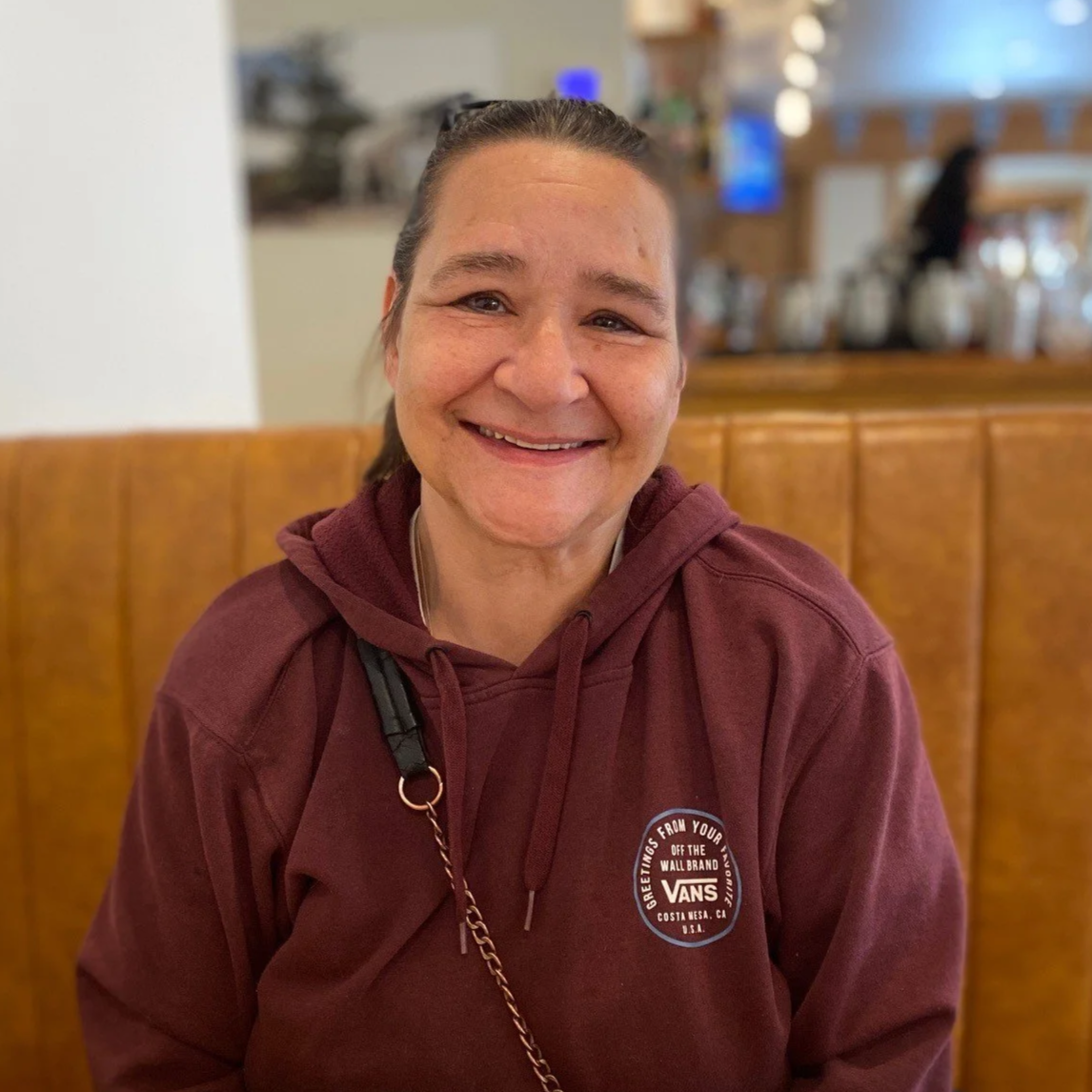
Rachel Oseguera recently lost her health insurance. It's just one of many setbacks she's faced in her life, although Rachel has also overcome a lot of hurdles. Her optimism keeps her moving forward.
Rachel Oseguera learned that her health insurance had been canceled when she went to pick up a prescription.
Rachel has had Apple Health, Washington State’s Medicaid program that provides free health care for low-income individuals, for as long as she can remember. Although she’d received a couple letters from Apple Health before she discovered her insurance was canceled, she said, “I didn’t really understand. I’ve had free insurance my whole life and this is so new.”
Rachel already had a meeting scheduled with MEND to see if she could get financial assistance. In addition to that help, MEND’s social worker, Liz, helped Rachel get on a phone call with someone from Washington Health Plan Finder, the state’s health insurance exchange.
“The lady told me I make $41 over the amount per month [to qualify],” Rachel said.
Rachel makes around $2,200 a month and has a daughter in high school who lives with her. Even with a dependent, her income was $41 too high to qualify for Apple Health. Instead, the broker said, she could choose between three different insurance plans available on the exchange—the cheapest of which was about $150 a month, with a deductible around $7000. Alternatively, if her income fell back below the threshold, she could upload her new pay stubs in 30 days and potentially qualify for free health insurance again.
Before she lost her insurance, Rachel had just had her bottom teeth pulled in anticipation of the dentures she’d planned to get. She’s no longer sure she’ll be able to afford them, now that copays and deductibles may be part of the equation.
Not long afterward, Rachel got another letter in the mail about her health insurance. They asked her to provide proof she was no longer incarcerated. Rachel hasn’t been in jail in 13 years.
It has taken Rachel a lot of work to get where she is now. Although she moved out on her own when she was 16, her struggles with addiction made it hard to create any sort of stability. She didn’t raise her four oldest children because of that same drug addiction that landed her in prison twice.
Perseverance pays off
Since then, however, a lot has changed. Rachel has been sober for 11 years. She is part of a close-knit church group that provides her with a lot of support. She has lived in the Upper Valley for seven years and raised her two youngest children.
Rachel got a job at a hotel in Leavenworth after getting out of prison. She used to ride the bus up from Wenatchee, where she was living with her kids. She’d tell them to pick the side of the highway in Leavenworth they wanted to live on. Rachel knew what she wanted—to live in the Upper Valley—and kept working to make that dream a reality.
“Wherever there’s a mountain, he can move it,” she told her kids. “God can do it.”
Her faith and perseverance paid off. With help from a rehousing program, Rachel was able to move into subsidized housing in Leavenworth—first into a two-bedroom, then into a three-bedroom unit when one became available.
“I was just on cloud 9,” she said. “It was my first house by myself. The first job I carried myself in.”
The Upper Valley has become home, where Rachel has a community of people who care about her. When her mother died of COVID, that community created a meal train for her and helped in any way they could.
“I was a wreck. My house was a wreck,” she said. “They wrapped their arms around me. I think in this community the people are to die for. Beautiful. Accepting.”
Rachel has tried hard to find a job that feels like a good fit. Before the COVID pandemic, she had a job helping others with their own substance use disorders at the Center for Drugs and Alcohol in Wenatchee. She loved the work.
“That job was my whole heart,” she said.
When her mother died, Rachel was devastated by the loss and decided to take family medical leave. By the time she was ready to return to work, she’d decided to apply for a different job, which wasn’t as great a fit. When it didn’t work out, she didn’t have the time to reapply for her old job—she needed to start getting a paycheck again and began looking in the Upper Valley, closer to home. After several tries to find work she liked, she landed at Dan’s Food Market in Leavenworth, which she also loves.
“At Dan’s, it fills my need for interaction with the public,” she said.
Despite many setbacks, Rachel’s natural optimism continues to shine through. “I’ve always looked at things in a positive way because I can’t dwell on the things I can’t change,” she says. “I just know that there will be better days.”
Rachel lights up when she talks about her family. She has six children and seven grandchildren, and she doesn’t take them for granted. It has taken her a lot of work to get to where she’s able to have relationships with many of them. She even got to go on a family vacation, which meant a lot to her. At the same time, figuring out how to continue to spend meaningful time together and offer them support without disrupting her hard-earned stability is an ongoing process.
“I don’t want any hard parts to hit my kids,” she says. “If I have it, I’ll help them. And even if I don’t, I’ll help them.”
Nevertheless, Rachel knows this is a hurdle like any other—one that she’ll be able to get through the same way she’s made it through other challenges she’s encountered so far.
“What is the next step?” she says she tells herself. “What can I do to better myself just a little bit more?”
Rachel has a very small window to decide on one of the paid options or upload new paystubs to get her insurance back. If she doesn’t act, she won’t have any insurance at all.
“Although a lot of my job is helping people find resources and providing financial assistance, I also help them navigate these complex systems that are hard to understand even at the best of times,” says Liz, the social worker. “It’s even harder when people are stressed and busy.”
In the meantime, Rachel is continuing to look ahead, envisioning what she wants her life to look like in the future. Ultimately, Rachel wants to have her own tiny house—space that belongs just to her and her dog.
“I am not going to give my dream up,” she says. “I’ve given up a lot of dreams but I’m not giving that one up.”