
Grant Gibbs' 50 years of organic farming
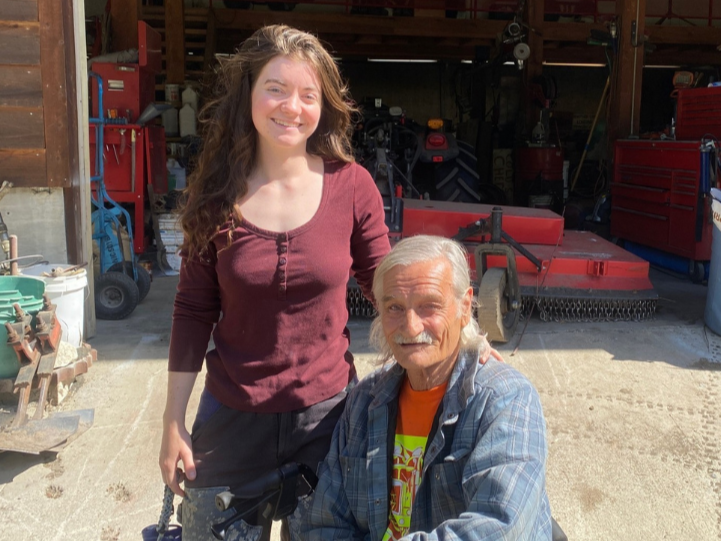
Jessie Nixon (left) and Grant Gibbs on Grant's farm. Grant has been an organic farmer in the Upper Valley for the last 50 years. Jessie works on the farm six days a week.
According to Grant Gibbs himself, he’s a stubborn man. According to others who know him, he’s also an interesting character, a talker, and a cornerstone of the local farming community. He is a fierce supporter of the Community Cupboard, regularly donating produce through the gleaning program. The Cupboard also buys some of his produce through a Farm to Food Pantry grant that provides funds to buy from local farmers.
Grant has been an organic farmer in North Central Washington for more than 50 years. His stubborn nature and willingness to share his decades of farming experience may be the reason the 74-year-old has been able to farm for as long as he has.
Grant first became acquainted with Upper Valley MEND because he needed their help to make ends meet—a memory that still makes him emotional to talk about.
“I’ve had to depend on Upper Valley MEND,” he said. “I’ve been so poor. I couldn’t pay my electric bill and I needed it to get my irrigation to work. Upper Valley MEND gave me help when I needed it and they came through for years, not just once. When I’m able, I have to give back.”
Grant says indigenous cultures taught him the concept of taking what you need but also giving back when you can. Although Grant used the Community Cupboard food pantry for food when he needed it, he also donated produce when he could—and still does.
“You do not just take,” he says. “You always give back.”
Although his title has always been organic farmer, Grant has adjusted and pivoted many times over his career to continue to make things work. At one point, he was farming both in the Upper Valley and the Chelan Valley. He also taught multiple generations of farmers about his techniques through hands-on experience working on his farm.
“I could house five people and feed them,” he said. “They didn’t have a wage, but they got a free education.”
In exchange for teaching what he knew, Grant got workers to help on the farm. With 30 acres on his property up Freund Canyon and other properties on the Chumstick Highway he farmed, he needed the help. Eventually, he pivoted again and invested in more machinery to help him farm so he could reduce the amount of manual labor required to grow his crops.
Yet even now, people seeking education in sustainable and organic farming find Grant.
“Grant’s a big yapper, which is great because I’m here to learn and absorb,” says Jessie Nixon.
Asking for help and offering knowledge in return
Jessie met Grant about three years ago and came to work with him in December 2025 after graduating from a bachelor’s program in sustainable food systems. By then, Grant had had to pivot yet again to figure out how to continue farming. In the summer of 2025—not long after a party celebrating his 50 years of farming—Grant had a stroke. By the time Jessie joined him, he’d recovered significantly but still had problems walking. Many of the everyday farming tasks he’d always done weren’t available to him, although he has continued to improve and can now help with raking, hoeing and weeding to some extent.
Despite the awareness of how Grant’s diminished ability to help would affect her own job, Jessie was still excited about the opportunity. Although several people help on the farm to some extent, Jessie is the primary worker.
“It’s a lot of me but not just me,” she says.
Jessie works five days a week on the farm itself in addition to selling its produce at the Leavenworth Farmers Market on Saturdays. In exchange for the work she does on the farm, Jessie and Grant split the proceeds from produce sales. This includes annual seed crops and Grant’s many permaculture crops that grow on his property: walnuts, rhubarb, marionberries, raspberries and seven varieties of cherries.
“I’m grateful for the opportunity and the connections Grant already has,” says Jessie. “How Grant and the land have cared for the community—I’m grateful to be a part of that.”
It’s clear Grant cares for the community by teaching people like Jessie—people whose hearts lie close to the land and what it can provide.
“I admire so much seeing any young farm start up; any young person that wants to get into any form of agriculture,” he says. “I totally want to be their mentor. Those people need to know me. And I’ll be the best cheerleader they could ever imagine. And you’ve got to learn from your mistakes and don’t look back and do it for the lifestyle and not the money. And that’s it. The end.”