
In honor of Earth Day: how MEND reduces waste
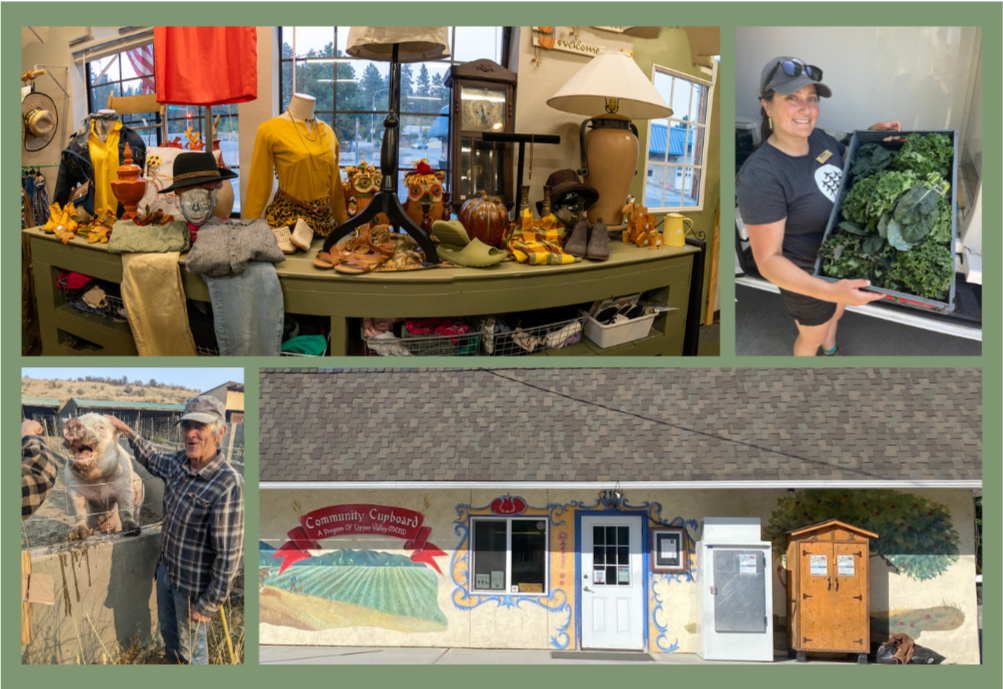
The community reduces waste through MEND in a number of ways, including those represented here. Clockwise from top left: Das Thrift gives used goods and clothing a second chance; former gleaning coordinator and new food systems coordinator Alana Springer gleans extra produce from the Wenatchee Farmers Market; Steve Scott from Gau-Sco Farm in Malaga is one of many farmers who take food waste from the Community Cupboard to feed their livestock; the Cupboard has a refrigerator and cupboard outside the door to make food that's about to expire available for anyone who needs it.
In honor of Earth Day this month, Upper Valley MEND is highlighting all the ways our community helps reduce waste through MEND’s programs.
Das Thrift
In addition to providing a place to get low-cost clothing and household items, Das Thrift also ensures gently-used items are given a chance at a second life. When items that still have life in them are donated to Das Thrift, it cuts down on waste while providing a lower-cost option for those goods for anyone who wants or needs them.
Gleaning
MEND’s gleaning program runs from April to November, gleaning extra produce from local farms, orchards, backyard gardens and local farmers markets. MEND’s gleaning coordinator takes calls from donors, determining roughly how much produce is available to be harvested. Based on amounts, the coordinator organizes the appropriate number of volunteers that will be able to complete the harvest in two-hour shifts.
There are many reasons local producers choose to donate their produce through the gleaning program. Often, it is simply because there’s more produce than they need and they don’t want to see the extra go to waste. Sometimes, the farmer or orchardist’s produce has been damaged in some way that makes it hard to sell. For instance, fruit that has been hit by hail may not be sellable on the commercial market, but that doesn’t affect its taste or nutritional value. This is when gleaning is an especially valuable way to ensure the fruit doesn’t go to waste.
Grocery Rescue
Grocery rescue is a program where local grocery stores donate items to the Community Cupboard. These items are donated for a number of reasons. None are expired, but some may be nearing their expiration date. Many items are donated to make room for a new shipment of the same product, or to make room for a new product on the grocery store’s shelves. This is especially true for seasonal items, such as the makings for pumpkin pie or stuffing.
In 2025, 24 percent of the food distributed at the Community Cupboard came from grocery rescue. These include popular items such as pre-made sandwiches and salads, yogurt, cheese and other food that can be eaten without a lot of preparation. Not only does this reduce the amount of waste at grocery stores, access to prepared, ready-to-eat food is helpful for many Cupboard shoppers. Many have limited or no access to kitchen facilities or may not have time to cook in addition to their jobs and family responsibilities.
Other ways MEND reduces waste
In addition to gleaning, the Cupboard also reduces waste in other ways. Cupboard staff and volunteers set aside fruit and vegetable waste that would be enticing to chickens, pigs and other lifestock and save it for several farmers who come in to pick it up on a regular basis. All additional food waste is composted through Winton Composting.
For food that is still good but may have a short shelf life, the Cupboard has a refrigerator outside its front door that anyone is welcome to help themselves to at any time. It is next to a wooden cupboard with other free items that don’t need to be refrigerated. This provides yet another option for food to be consumed up to its expiration date. It also ensures food is available in case someone needs it, even when the Cupboard is closed.
“We're trying to feed as many people as we can while maintaining a quick turnaround of items on the shelves so nothing goes to waste,” says Assistant Community Cupboard Manager Lily Roberts. “We have food. We have people who need food. Let’s get the food to the people who need food. It’s a simple equation.”
By supporting MEND, you’re helping support your community in multiple ways. Not only are you supporting your neighbors who need it, you’re also helping to reduce waste while providing that support.